Relativity can feel like physics for black holes and spaceships, far removed from everyday life. Yet every time your phone shows the blue dot on a map, it relies on corrections for two different relativistic effects. Without them, the system would be useless within hours.
How GPS finds you
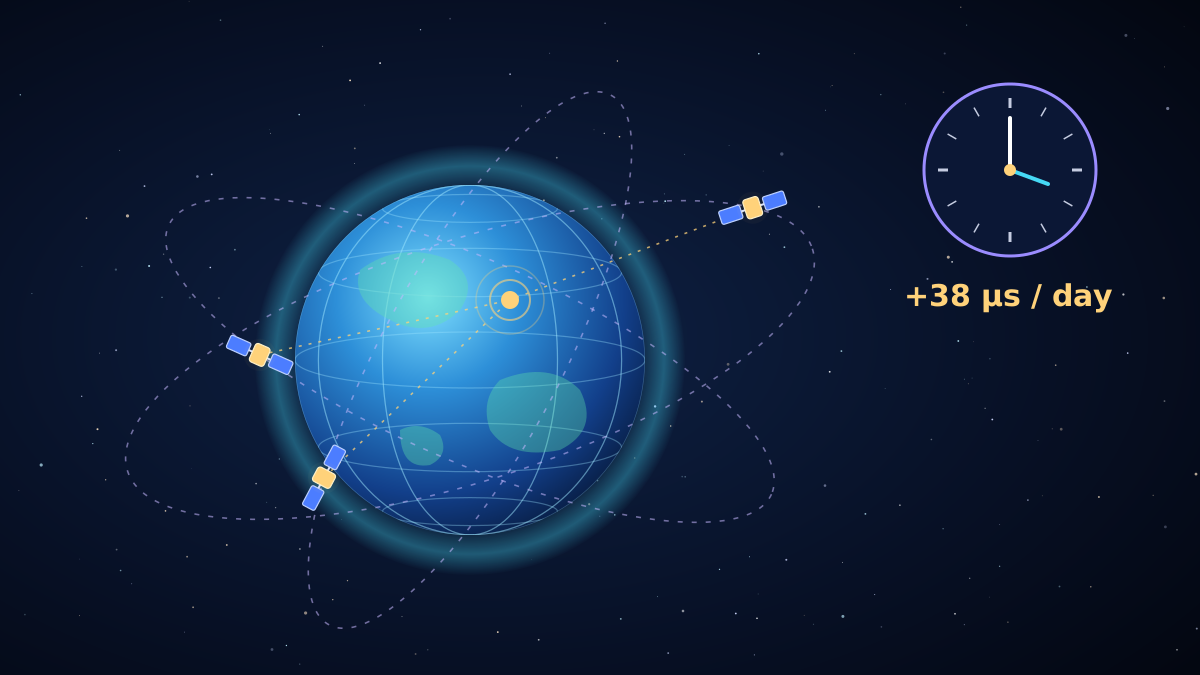
The Global Positioning System is a constellation of at least 24 operational satellites (usually around 31) orbiting about 20,200 km above Earth. Each one circles the planet roughly twice a day.
Every satellite carries atomic clocks and continuously broadcasts two things: where it is, and exactly what time it is. Your receiver notes when each signal arrives. From the delay it works out how far away each satellite is. With signals from at least four satellites, it can solve for its three-dimensional position plus the error of its own, much cheaper clock.
Why nanoseconds matter
Radio signals travel at the speed of light: about 30 centimetres per nanosecond. A timing error of a single microsecond (a millionth of a second) becomes a range error of 300 metres. To locate you within a few metres, the satellite clocks must stay synchronised to within a few billionths of a second.
At that level of precision, Einstein stops being optional.
Special relativity: moving clocks run slow
Einstein's 1905 theory of special relativity says that a moving clock ticks more slowly than a stationary one. GPS satellites travel at about 3.9 kilometres per second. That is slow by cosmic standards, but fast enough for their clocks to fall behind ground clocks by about 7 microseconds per day.
General relativity: clocks run faster higher up
General relativity (1915) adds a second effect: clocks deeper in a gravitational field tick more slowly. At 20,200 km the satellites feel noticeably weaker gravity than we do on the surface, so their clocks run faster, by about 45 microseconds per day.
Putting it together
The two effects pull in opposite directions, but gravity wins. Net result: each satellite clock gains about 38 microseconds per day relative to clocks on the ground.
Multiply 38 microseconds by the speed of light and you get a ranging error of about 11 kilometres. Left uncorrected, it would keep piling up day after day, usually summarised as "about 10 km per day".
Engineers cancel most of the effect before launch. The clocks' reference frequency is set slightly low: 10.22999999543 MHz instead of the nominal 10.23 MHz. In orbit they then tick at exactly the right rate as seen from the ground. Receivers apply one more small correction, because the slightly elliptical orbits make the effect vary along each pass.
Every phone with a satellite navigation chip is, quietly, a working test of relativity.
The same physics applies to Europe's Galileo, Russia's GLONASS and China's BeiDou. Any satellite navigation system has to account for it.
Key takeaways
- GPS measures distance with time, so clocks must agree to within nanoseconds.
- Orbital speed slows satellite clocks by ~7 μs/day; weaker gravity speeds them up by ~45 μs/day.
- The net +38 μs/day would cause errors of roughly 10 km per day.
- Satellite clocks are deliberately tuned slightly slow before launch to compensate.
Sources & further reading
N. Ashby (2003), "Relativity in the Global Positioning System", Living Reviews in Relativity 6, 1; U.S. Government, GPS.gov, "Space Segment"; C. M. Will, "Einstein's Relativity and Everyday Life", American Physical Society.