Ask how big the universe is and you will usually get one of two answers: "nobody knows" or "about 93 billion light-years". Both are correct. The difference lies in a single word, observable, and in one of the strangest facts in physics: space itself is expanding.
The short answer
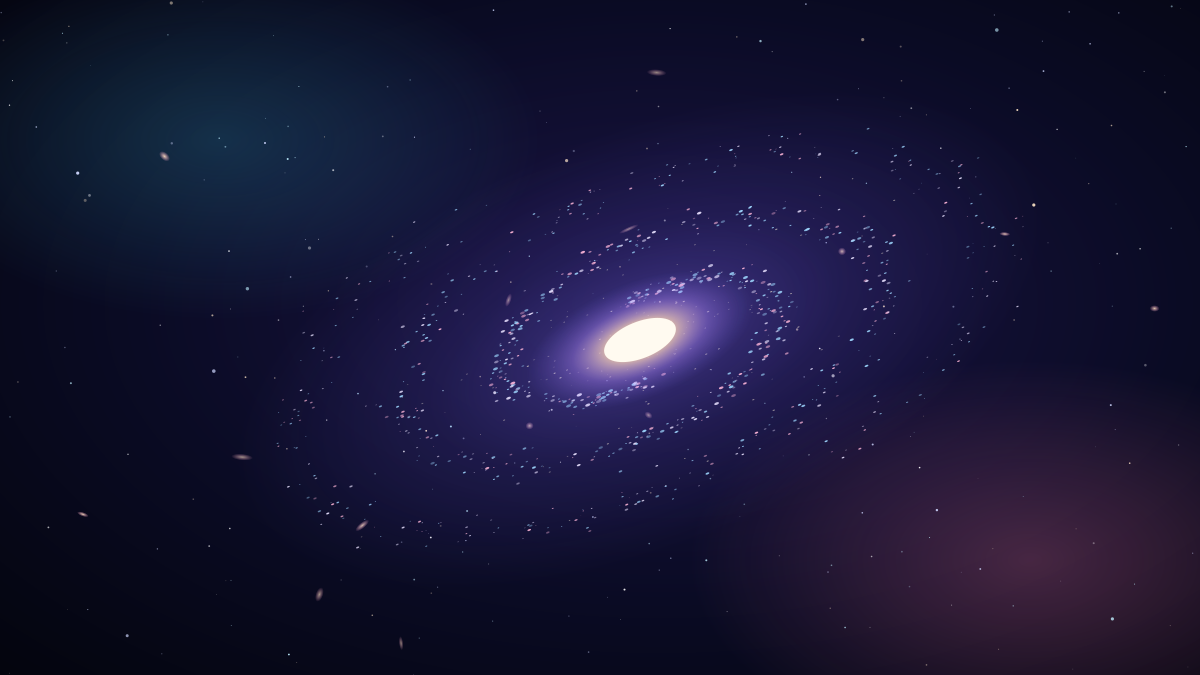
The observable universe is a sphere centred on us with a radius of roughly 46.5 billion light-years. That makes it about 93 billion light-years across. Inside it are hundreds of billions of galaxies; some estimates put the number closer to two trillion. Every one of those galaxies holds millions to hundreds of billions of stars.
Why it is bigger than 13.8 billion light-years
If the universe is 13.8 billion years old and nothing travels faster than light, you might expect to see 13.8 billion light-years in every direction and no further. But that reasoning assumes a static universe. Ours has been expanding the entire time.
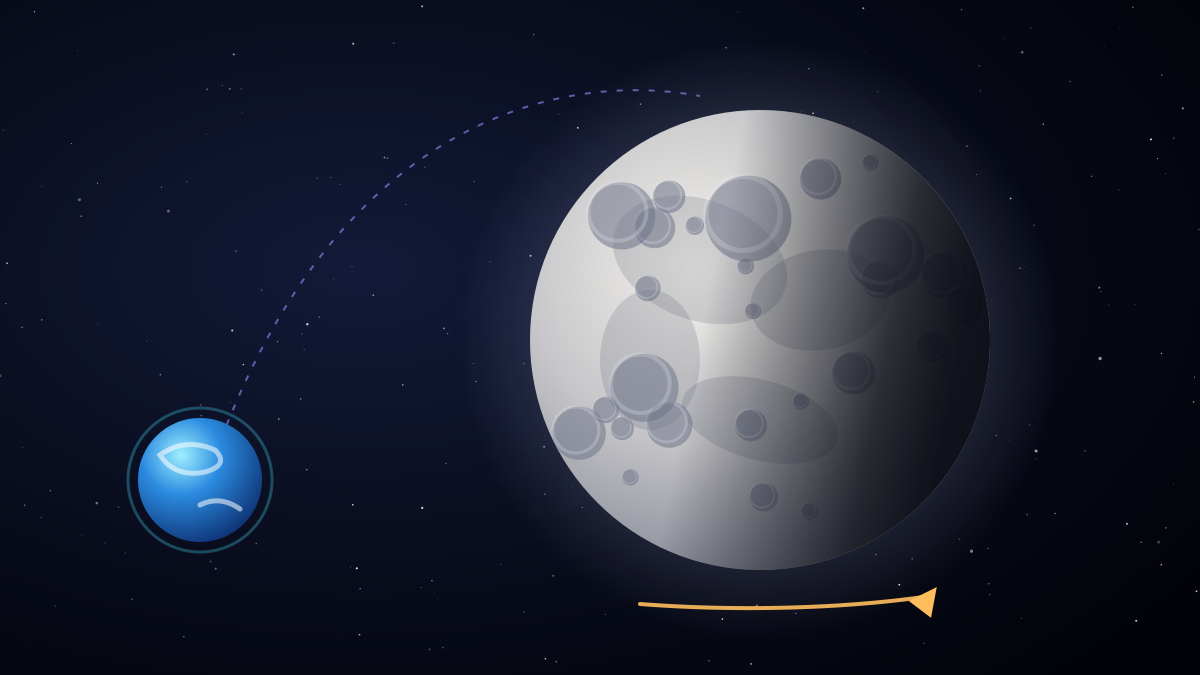
Picture light leaving a young galaxy shortly after the Big Bang. While that light crosses space towards us, the space it is crossing keeps stretching. The light arrives after a journey of almost 13.8 billion years, but the galaxy that emitted it has been carried much farther away in the meantime. Today it sits roughly 46 billion light-years from us.
Nothing outruns light through space. Space itself, however, is free to grow.
This does not break Einstein's speed limit. No object moves through space faster than light. Very distant galaxies recede faster than light only because the amount of space between us grows over time.
The edge we can actually see
The oldest light we can detect is the cosmic microwave background (CMB). For its first 380,000 years the universe was a hot, dense fog of charged particles that scattered light in every direction. When it cooled to about 3,000 kelvin, electrons and nuclei combined into neutral atoms. The fog cleared, and light could travel freely for the first time.
Expansion has since stretched that ancient glow from visible and infrared light into microwaves, and it now has a temperature of just 2.725 K. Arno Penzias and Robert Wilson discovered it by accident in 1965, while trying to remove a stubborn hiss from a radio antenna. Satellites such as COBE, WMAP and Planck later mapped it in exquisite detail.
Light cannot show us anything earlier than the CMB, because the young universe was opaque to it. In principle, neutrinos and gravitational waves could one day let us look even further back.
How astronomers measure such distances
No single method reaches across the cosmos, so astronomers use a "distance ladder" in which each rung calibrates the next:
- Parallax. Nearby stars shift slightly against the background as Earth orbits the Sun. The Gaia spacecraft has measured this for more than a billion stars.
- Cepheid variables. In 1912, Henrietta Swan Leavitt discovered that these pulsating stars brighten and fade with a period tied to their true brightness. That makes them "standard candles" out to tens of millions of light-years.
- Type Ia supernovae. These exploding white dwarfs reach a predictable peak brightness and can be seen across billions of light-years.
- Redshift. Expansion stretches light to longer, redder wavelengths. The more it has stretched, the farther the light has travelled.
The expansion rate is the Hubble constant, and two kinds of measurement disagree about it. The CMB points to about 67 kilometres per second per megaparsec, while nearby supernovae suggest about 73. This "Hubble tension" is one of the biggest open questions in cosmology.
Is the whole universe bigger?
Almost certainly. The observable universe is only the region from which light has had time to reach us. Measurements of the geometry of space show it to be extremely close to flat. That suggests the whole universe is far larger than the part we can see, and it may well be infinite.
There is a twist: expansion is accelerating, driven by what we call dark energy. As a result, light emitted today by galaxies more than about 16 billion light-years away will never reach us. Over tens of billions of years, distant galaxies will slip out of view one by one.
Key takeaways
- The observable universe is about 93 billion light-years across.
- It is larger than 13.8 billion light-years because space expanded while the light was travelling.
- The cosmic microwave background, released 380,000 years after the Big Bang, is the oldest light we can see.
- The entire universe is probably much bigger than the observable part, possibly infinite.
Sources & further reading
NASA WMAP mission, "Universe 101"; Planck Collaboration (2020), "Planck 2018 results. VI. Cosmological parameters", Astronomy & Astrophysics; H. S. Leavitt & E. C. Pickering (1912), "Periods of 25 Variable Stars in the Small Magellanic Cloud", Harvard College Observatory Circular.