The James Webb Space Telescope (JWST) took decades to design and build, and it had to unfold itself perfectly in deep space with no chance of a repair visit. Since its first images in July 2022 it has rewritten textbooks on the early universe and on planets around other stars. Here is how it works.
A launch on Christmas Day
Webb lifted off on 25 December 2021 aboard an Ariane 5 rocket from Europe's Spaceport in Kourou, French Guiana. It is a partnership between NASA, the European Space Agency and the Canadian Space Agency.
The telescope was far too large to launch fully assembled, so it travelled folded up like origami. Over the next two weeks it deployed its sunshield and mirrors. NASA counted 344 potential single points of failure in the sequence, and every step worked. Webb reached its operating orbit on 24 January 2022.
The golden mirror
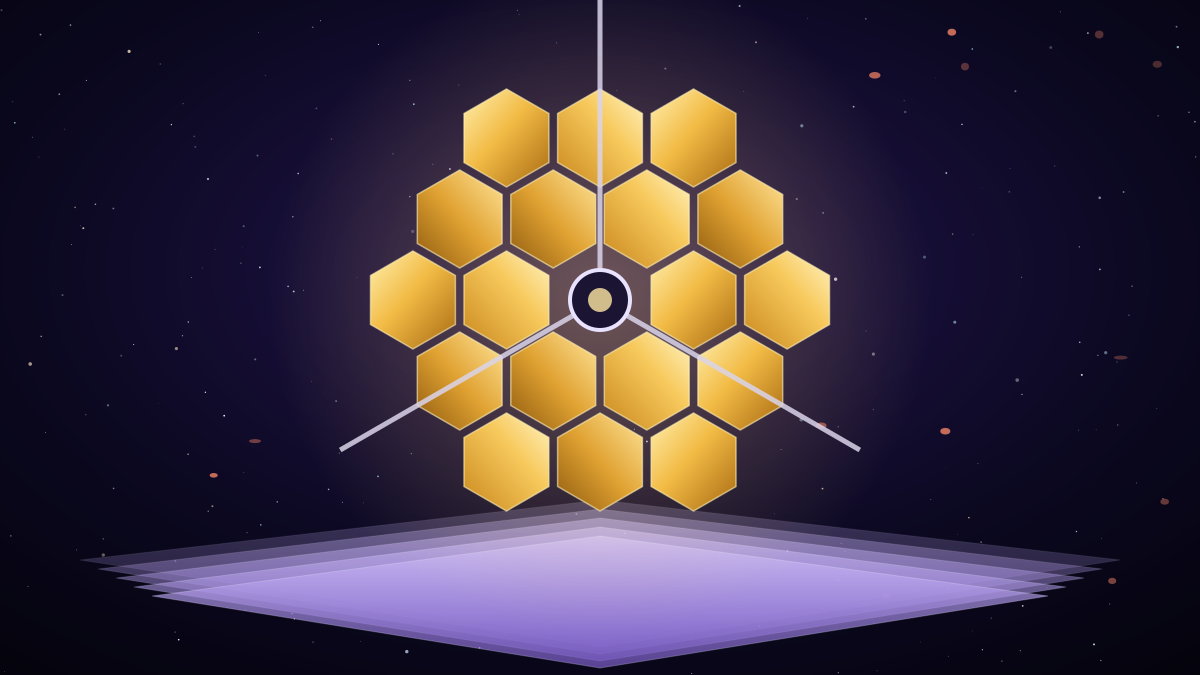
Webb's primary mirror is 6.5 metres across and built from 18 hexagonal segments of lightweight beryllium. Each segment is coated with a microscopically thin layer of gold, which reflects infrared light exceptionally well.
The collecting area is about 25 square metres, roughly six times that of Hubble's 2.4-metre mirror. Tiny motors behind each segment adjust its position and curvature, so all 18 act as a single smooth mirror, aligned to a small fraction of a wavelength of light.
Why it needs to be so cold
Webb observes mainly in infrared, which is essentially heat radiation. To detect the faint infrared glow of distant galaxies, the telescope must be far colder than its targets; otherwise its own warmth would swamp the signal.
The solution is a five-layer sunshield of a thin, reflective plastic film called Kapton, about the size of a tennis court. On the Sun-facing side temperatures reach around 85 °C. On the shaded side, where the mirror and instruments sit, they drop to about −233 °C. The Mid-Infrared Instrument (MIRI) needs even more chill, so a cryocooler takes it below 7 kelvin.
Parking at L2
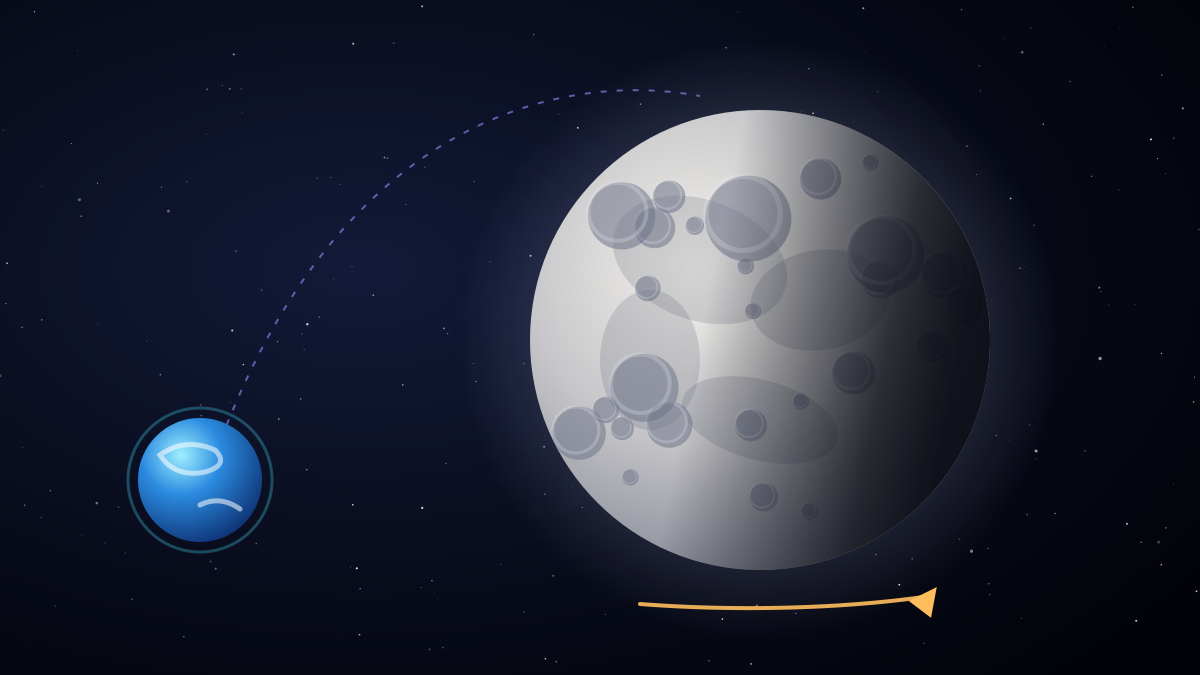
Webb orbits the Sun–Earth second Lagrange point (L2), about 1.5 million kilometres from Earth in the direction away from the Sun. That is nearly four times farther than the Moon. From there the Sun, Earth and Moon all stay on the same side, so the sunshield can block all three at once and keep the telescope permanently in the cold.
Webb doesn't sit exactly at L2. It traces a large "halo" orbit around it, using small thruster burns to stay on track. Its precise launch saved so much propellant that NASA expects it to keep operating for well beyond its ten-year baseline mission.
What Webb has discovered
- The earliest galaxies. Webb has confirmed galaxies whose light left them less than 300 million years after the Big Bang. Many are brighter and more mature than models predicted.
- Exoplanet atmospheres. In 2022 it made the first clear detection of carbon dioxide in the atmosphere of a planet beyond the Solar System, the hot gas giant WASP-39 b.
- Early black holes. It keeps finding supermassive black holes in the young universe that seem to have grown surprisingly fast.
- Stunning images. Its views of stellar nurseries, such as the "Cosmic Cliffs" in the Carina Nebula, show newborn stars hidden from Hubble behind curtains of dust.
Key takeaways
- Webb launched on 25 December 2021 and released its first images in July 2022.
- Its 6.5 m mirror of 18 gold-coated segments gathers about six times more light than Hubble's.
- A five-layer, tennis-court-sized sunshield keeps the optics near −233 °C for infrared observing.
- It orbits L2, 1.5 million km from Earth, and sees galaxies from less than 300 million years after the Big Bang.
Sources & further reading
NASA Goddard, James Webb Space Telescope mission pages; ESA, "Webb" mission overview; JWST Transiting Exoplanet Community Early Release Science Team (2023), "Identification of carbon dioxide in an exoplanet atmosphere", Nature; S. Carniani et al. (2024), "Spectroscopic confirmation of two luminous galaxies at a redshift of 14", Nature.