For most of the twentieth century, black holes were a mathematical curiosity. Many physicists, including at times Einstein himself, doubted nature would really allow them. Today we have measured their masses, recorded the gravitational waves from their collisions and taken pictures of two of them. Here is what they are, without the equations.
What a black hole actually is
A black hole is a region of space where gravity is so strong that nothing can escape it, not even light. It forms whenever enough mass is squeezed into a small enough volume.
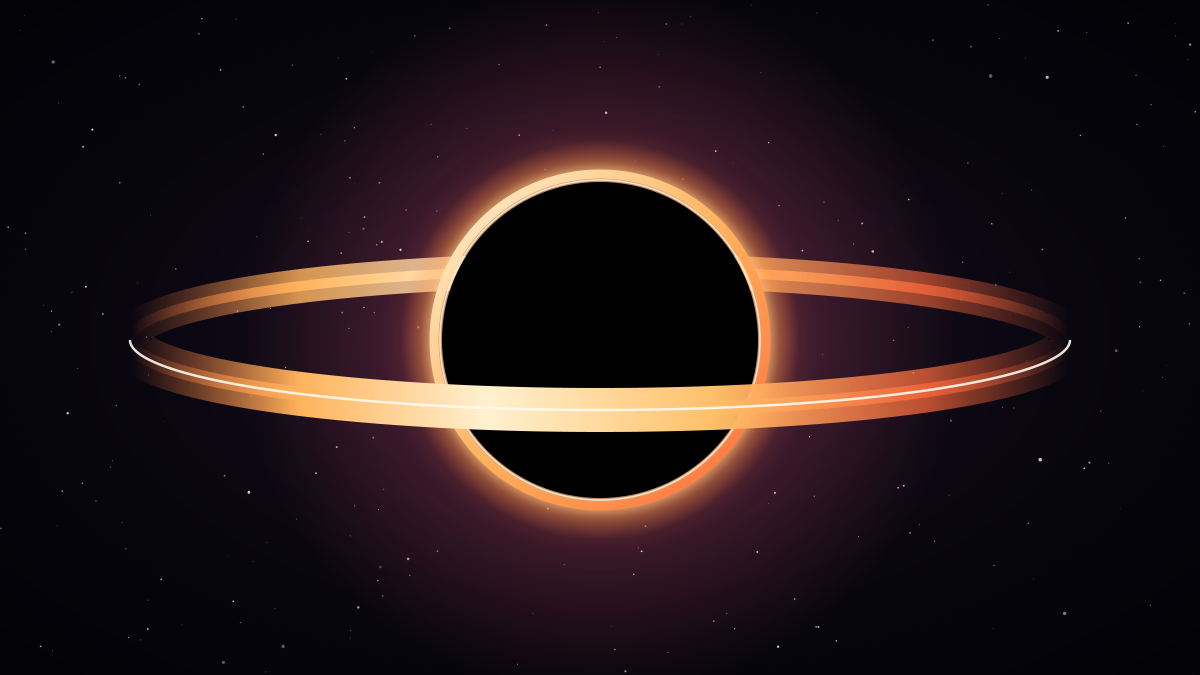
Its boundary is the event horizon. This is not a solid surface. It is a point of no return: outside it you can still escape with enough thrust, and inside it every possible path leads further in. Because no light leaves the horizon, the black hole itself is truly black. Everything we "see" comes from matter around it.
How small would Earth need to be?
Any mass becomes a black hole if it is compressed within its Schwarzschild radius, named after Karl Schwarzschild, who solved Einstein's equations for this case in 1916:
For the Sun, that radius is about 3 kilometres. For Earth, it is about 9 millimetres: you would have to squeeze the entire planet into something the size of a marble. Nothing in nature can do that to a planet. The collapse of a massive star can do it to a stellar core.
How black holes form
Stellar-mass black holes are born when stars many times heavier than the Sun run out of fuel. With nothing left to hold it up, the core collapses in a fraction of a second, often triggering a supernova. If the remaining core is heavier than about three Suns, no known force can stop the collapse, and a black hole forms.
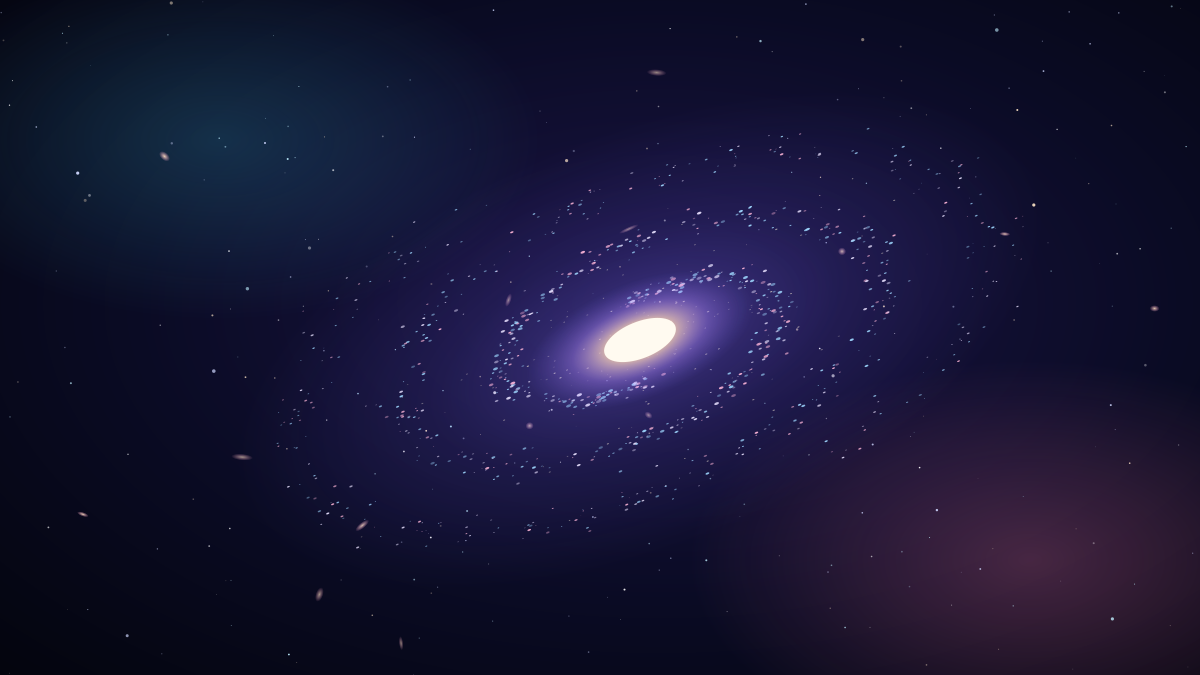
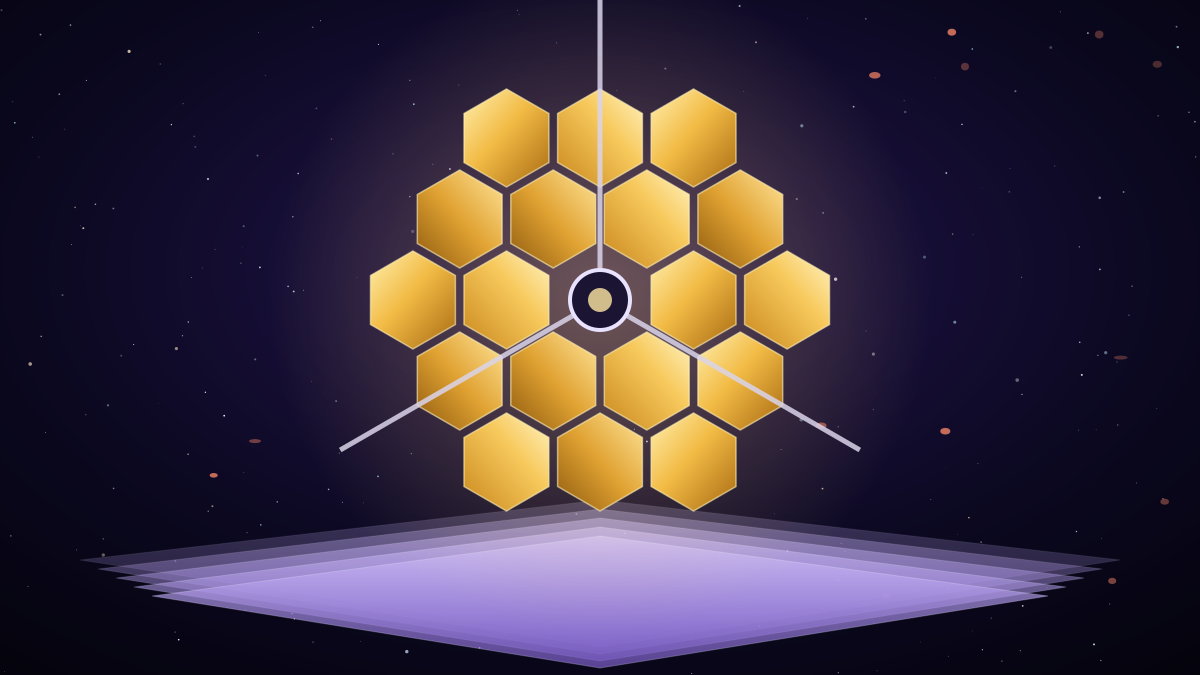
Supermassive black holes, millions to billions of times the Sun's mass, sit at the centres of most large galaxies. How they grew so big, so early, is still an open question. The James Webb Space Telescope keeps finding surprisingly massive black holes in the young universe.
The giant at the centre of our galaxy
About 26,000 light-years away, at the heart of the Milky Way, lies Sagittarius A*, a black hole roughly four million times the mass of the Sun. Astronomers worked this out by tracking stars whipping around an invisible object for decades. One star, S2, completes an orbit every 16 years.
That work earned Reinhard Genzel and Andrea Ghez half of the 2020 Nobel Prize in Physics. The other half went to Roger Penrose, for showing that black hole formation follows robustly from general relativity.
Seeing the invisible
In April 2019, the Event Horizon Telescope, a network of radio dishes spread across the globe that works like one Earth-sized telescope, released the first image of a black hole. It showed M87*, a 6.5-billion-solar-mass giant 55 million light-years away, as a dark shadow ringed by glowing gas. In May 2022 the same team unveiled an image of Sagittarius A*.
Black holes can also be heard, in a sense. On 14 September 2015, the LIGO detectors registered gravitational waves (ripples in spacetime) from two black holes of about 36 and 29 solar masses merging 1.3 billion light-years away. The discovery won the 2017 Nobel Prize in Physics.
Myths worth retiring
- "Black holes suck everything in." At a distance, a black hole pulls no harder than any other object of the same mass. If the Sun were replaced by a black hole of equal mass, Earth's orbit would not change, though it would get very cold and dark.
- "Crossing the horizon is instantly fatal." For a supermassive black hole, tidal forces at the horizon are gentle. Near small, stellar-mass black holes, the stretching (nicknamed "spaghettification") would tear you apart before you reached it.
- "Black holes last forever." In 1974 Stephen Hawking predicted that black holes slowly emit radiation and lose mass. For a stellar-mass black hole, though, evaporation would take vastly longer than the current age of the universe.
Key takeaways
- A black hole is a region where gravity prevents anything, even light, from escaping; its boundary is the event horizon.
- Earth would become a black hole only if squeezed to about 9 mm across.
- Our galaxy hosts a four-million-solar-mass black hole, Sagittarius A*.
- We have imaged two black holes (2019, 2022) and detected their collisions through gravitational waves (2015).
Sources & further reading
Event Horizon Telescope Collaboration (2019, 2022), The Astrophysical Journal Letters; LIGO Scientific Collaboration and Virgo Collaboration (2016), "Observation of Gravitational Waves from a Binary Black Hole Merger", Physical Review Letters; The Nobel Prize in Physics 2020, press release.