Look up at a full Moon tonight and you will see the same dark patches people saw thousands of years ago: the "man in the Moon", the rabbit, the face. Throughout history humans have only ever seen one side of our neighbour from the ground. The reason is a slow gravitational tug-of-war called tidal locking.
The Moon does rotate
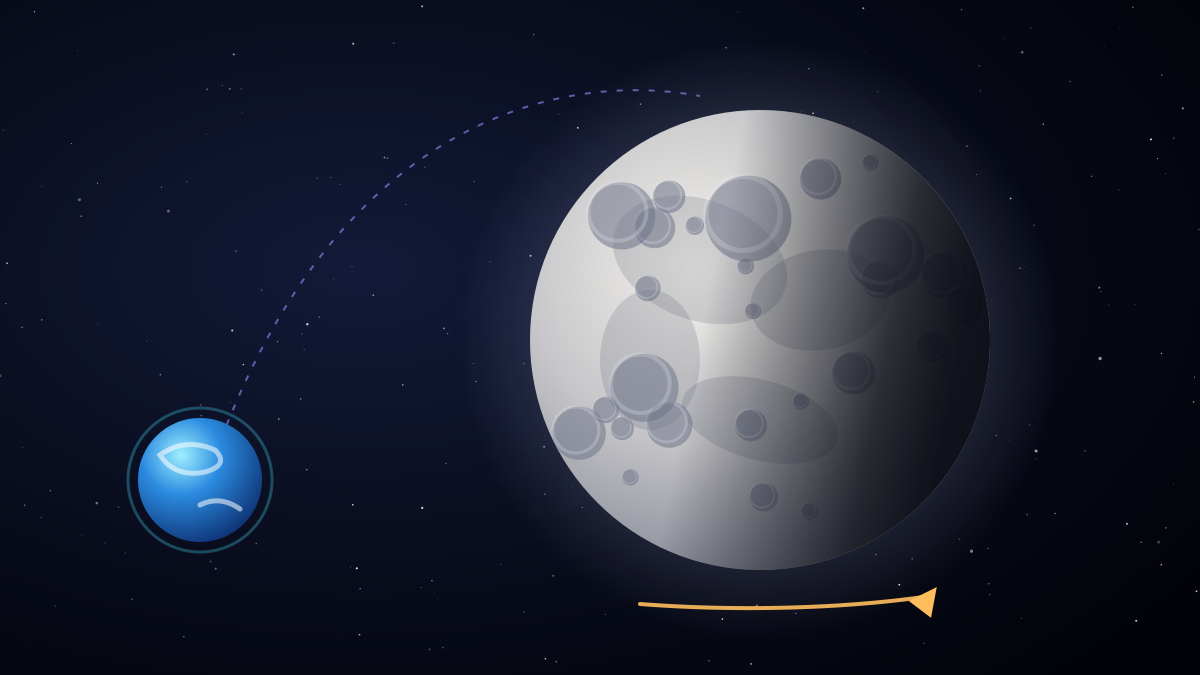
A common misconception is that the Moon doesn't spin. It does, once every 27.3 days. That is exactly the time it takes to orbit Earth, and because the two periods match, the same hemisphere always faces us.
You can try it yourself: walk in a circle around a chair while always facing it. By the time you are back where you started, you have turned all the way around once, yet the chair has only ever seen your front.
How tidal locking happens
Earth's gravity pulls more strongly on the near side of the Moon than on the far side, stretching it very slightly. This raises two tidal bulges in its rock, one facing Earth and one facing away.
Early in its history the Moon spun faster, and its rotation kept dragging those bulges ahead of the Earth–Moon line. Earth's gravity tugged back on them, acting like a brake on the Moon's spin. Over time the spin slowed until it matched the orbit exactly. In that state the bulges stay lined up with Earth, the braking stops, and the arrangement is stable.
We actually see 59 percent
Although one face always points our way, we can peek a little around the edges. The Moon's orbit is slightly elliptical, so its orbital speed varies while its spin stays constant. Its orbit and axis are also slightly tilted. Together these produce a slow rocking motion called libration. Over time, observers on Earth can see about 59% of the lunar surface.
The far side isn't dark
"The dark side of the Moon" is a myth, or at least a misnomer. The far side receives just as much sunlight as the near side. During a new Moon, when the near side looks dark to us, the far side is fully lit. It was "dark" only in the sense of unknown.
That changed in October 1959, when the Soviet probe Luna 3 returned the first photographs of it. They revealed a surprise: the far side has almost none of the dark lava plains (maria) that dominate the near side, and its crust is thicker. In January 2019, China's Chang'e 4 made the first soft landing on the far side. In June 2024, Chang'e 6 brought back the first samples from it.
Earth is slowing down too
The Moon raises tides on Earth as well, in the oceans and even in solid rock. Friction from those tides acts as a gentle brake on Earth's rotation and transfers momentum to the Moon. As a result, Earth's day is getting longer by roughly 2 milliseconds per century, and the Moon drifts about 3.8 centimetres farther away each year.
We know that last figure precisely because Apollo astronauts left mirrors on the lunar surface. Observatories still fire lasers at them and time the reflections. In the very distant future Earth would also become locked to the Moon, but the Sun will change dramatically long before that could happen.
Locked worlds everywhere
Tidal locking is the rule, not the exception. Most large moons in the Solar System are locked to their planets, including Jupiter's four Galilean moons and Saturn's Titan. Pluto and its moon Charon are mutually locked: each always shows the same face to the other. Many exoplanets orbiting close to small red dwarf stars are probably locked too, with a permanent day side and a permanent night side.
Key takeaways
- The Moon rotates once per orbit (27.3 days), so the same side always faces Earth.
- Tidal forces from Earth slowed the Moon's spin until it locked into this state.
- Thanks to libration, we can see about 59% of the surface over time.
- The far side gets as much sunlight as the near side; it was first photographed in 1959.
Sources & further reading
NASA Science, "Moon: Facts" and "Tidal Locking"; J. G. Williams & D. H. Boggs (2016), "Secular tidal changes in lunar orbit and Earth rotation", Celestial Mechanics and Dynamical Astronomy; China National Space Administration, Chang'e 4 and Chang'e 6 mission releases.