It is one of the first scientific questions children ask, and many adults still can't quite answer it. The full explanation takes in physics, chemistry and biology, and it also tells you why sunsets glow orange, why clouds are white and why the sky on Mars works the other way round.
Sunlight is every colour at once
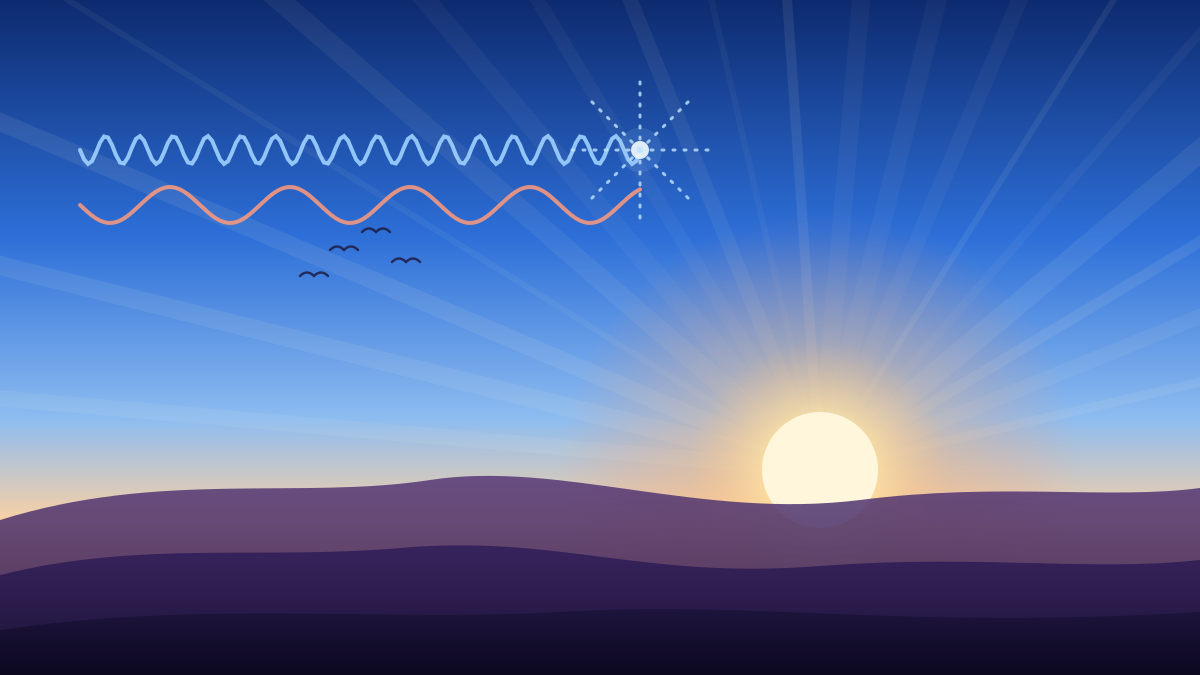
Sunlight looks white, but it is a mixture of every colour of the rainbow. Isaac Newton showed this in the 1660s by splitting sunlight with a prism. Each colour corresponds to a wavelength, from violet at around 400 nanometres to red at around 700.
On its way to your eyes, that light passes through the atmosphere: a thin blanket made mostly of nitrogen and oxygen molecules. What happens when light meets those molecules is the key to the whole story.
Rayleigh scattering: small molecules, big effect
Air molecules are far smaller than the wavelength of visible light. When light hits such tiny particles, some of it is redirected in new directions. This is called scattering. In 1871 the British physicist Lord Rayleigh worked out that the strength of this scattering depends very steeply on wavelength:
Because of that fourth power, halving the wavelength makes scattering sixteen times stronger. Blue light at 450 nm is scattered almost six times more strongly than red light at 700 nm.
So when you look at any patch of sky away from the Sun, you are seeing sunlight that air molecules have bounced towards you. Most of that redirected light is blue.
So why isn't the sky violet?
If shorter wavelengths scatter more, violet should win. Three things stop it:
- The Sun emits less violet than blue, so there is less of it to scatter.
- Some of the shortest wavelengths are absorbed high in the atmosphere.
- Our eyes are much less sensitive to violet. The mix of scattered light stimulates our three types of cone cells in a ratio the brain reads as pale blue.
In other words, the colour of the sky is partly a fact about the atmosphere and partly a fact about us.
Why sunsets turn red and orange
When the Sun is low, its light travels through far more air before it reaches you. At the horizon, the path is about 38 times longer than when the Sun is directly overhead. Along the way, most of the blue is scattered out of the beam, and the light that reaches your eyes directly is dominated by yellows, oranges and reds.
Dust, smoke and volcanic aerosols can make sunsets even more vivid. After the eruption of Krakatoa in 1883, people around the world reported blood-red skies for months. Similar effects followed Mount Pinatubo in 1991.
Why clouds are white
Cloud droplets are much larger than air molecules: comparable to, or bigger than, the wavelength of light. Particles that size scatter all visible colours about equally, a process called Mie scattering. Equal amounts of every colour look white. Thick storm clouds look grey simply because less light makes it through them.
The sky on Mars works in reverse
On Mars, fine iron-rich dust gives the daytime sky a butterscotch tint. At sunset, the area around the Sun turns blue, because dust particles of just the right size scatter blue light forward, close to the direction it was already travelling. NASA's rovers have photographed these eerie blue sunsets several times.
Key takeaways
- Air molecules scatter short (blue) wavelengths far more strongly than long (red) ones: Rayleigh scattering.
- The sky isn't violet because sunlight holds less violet, some is absorbed, and our eyes are less sensitive to it.
- At sunset, light crosses so much air that most blue is scattered away, leaving reds and oranges.
- Clouds are white because large droplets scatter all colours equally.
Sources & further reading
Lord Rayleigh (J. W. Strutt) (1871), "On the light from the sky, its polarization and colour", Philosophical Magazine; NASA Space Place, "Why Is the Sky Blue?"; NASA/JPL-Caltech, Curiosity rover sunset images from Gale Crater (2015).